Showing posts with label BBC. Show all posts

Thursday, August 11, 2011

Elementary my dear Watson....run!


He may be synonymous with crafty detective work and putting criminals behind bars, but it seems that even Sherlock Holmes never saw this one coming. Mark Gatiss, the executive producer and co-writer of BBC show Sherlock, tweeted how the cast and crew had to abandon the set during the London riots. "This is a new one on me. Scene incomplete owing to approaching looters. Unbelievable times," he tweeted (http://twitter.com/#!/Markgatiss). "Unit evacuated. F*****g terrifying!". The i, P15

hat tip to Media Guardian

Wednesday, February 23, 2011

Interactive Reporting on the Beeb: Corrections and Lessons


Veteran journalist Paul Reynolds reflects on journalism's future after his decade online:


As I leave my post as world affairs correspondent for the BBC News website, I would like to reflect on the shock I experienced nine years ago when I left the "mainstream" BBC to join the then orphan child of News Online.

I found that I was in direct contact with the public. Horror. This had not happened to me before.

For several decades, I had been broadcasting from a studio or on location at home and abroad, but always insulated from the listeners. Letters, then the only means of communication to a correspondent, were quite rare.

Someone would occasionally write in and the BBC postal system would catch up with me some days, or even weeks, later. It was, perhaps, a word of praise or a hint of complaint. Sometimes I replied. Sometimes I did not.

But writing online proved to be a different experience. It means the piece sits there in front of the reader. It is not something they might have half-heard over the airwaves. And they can contact you immediately. They do.

I joined in the spirit of openness by putting my e-mail address at the bottom of all my stories. This meant, of course, that I opened a pathway for comment or complaint, and this became a very crowded conduit at times.

I suddenly felt like a government minister at parliamentary question time. At first it was bruising. Slowly, though, I began to develop the kind of thick skin that politicians have. I came to understand how they can survive, enjoy even, the cut and thrust of public debate and insult. Something about ducks and water came to mind.

Insults had little effect after a time. After all, they are simply emotions. They contain no arguments. Arguments have more impact, much more. They force you to reconsider your stance. Is the BBC, are you, really taking an impartial, balanced position? What always hurt was when someone pointed out an error of fact.

I had a policy of replying to all but the most foul-tongued messages, and found that even those who had sworn at me in their first flush of anger often apologised when I asked for argument, not insult, and they had had time to calm down. That is one of the characteristics of the internet - instant access can lead to instant channelling of anger, often regretted later.

I engaged in quite long e-mail correspondences with various critics. Of these, I remember an American living in London who thought the BBC very overrated and very leftist. On the other side was MediaLens, whose editors and contributors believe that the BBC is a corporatist supporter of the establishment.

Both, in fact, had corrections to offer and lessons to teach. But the BBC could not survive if it took advice solely from either of them.

My liveliest exchanges, however, revolved around two specific subjects - 9/11 and the Middle East.

I disturbed the hornets' nest of 9/11 conspiracy theorists while sceptically reviewing a film called Loose Change, which claimed that 9/11 was a set-up by the Bush administration.

There were, I think, probably a couple of hundred outraged responses. One reader took me all the way through the formal BBC complaints system on the grounds that I had misrepresented the film, as if it was some well-considered documentary. The complaints panel decided it was not.

Complaining is now very easy, by the way, and the BBC explains how you can do it. You do not even need to live in the UK. This reader lived in Canada.
Source of news

The other e-mail storm followed a story I wrote about Gaza, which said that people should not believe everything they see on video taken in conflict situations. The example was Israeli video of an attack on men supposedly loading Grad rockets onto a truck. It turned out that the "rockets" might well simply have been oxygen cylinders.

Palestinian supporters wrote in by the dozen to say that, at last, the BBC had seen through Israeli propaganda. Israeli supporters accused me of naivety and worse.
British letterbox Paul Reynolds has signed off now, so that letter might not reach him

Then I did the reverse story. I said people should not trust the language used in conflict, concentrating this time on the words of Hamas, which often hid a harder intent. Of course, the e-mails this time were the other way round - praise from Israeli supporters, complaints from Palestinian.

The other thing I have experienced over the past few years is the growth of the internet as a source of news. I gave a talk some time ago to a school of journalism and said that the concept of the world waiting for news crews to get to disaster zones was over - witnesses there would be taking their own pictures.

This process would then develop in ways we cannot foresee, the "unknown unknowns". The lecturer on that course had his doubts but the trend has accelerated even faster than many of us thought it would.

The internet has become not only a resource for journalists, it is becoming part of the news itself.

And I have seen how the BBC News website is no longer an orphan child. Many in the wider organisation have leaped forward to claim, if not paternity, then guardianship. But it has changed the BBC and will go on doing so, while preserving, one hopes, the best of BBC practice.

Welcome to the future.

Monday, August 2, 2010

Digital Tampering 101

Hat tip to the Beeb, for the link to this piece about the perils of digitally tampering with news photos. Don't do it. Fakery is dishonest and readily detectable. Dozens of faked images are posted here for scrutiny, from the Economist's British Petroleum/Obama cover to Winston Churchill's belatedly cigar-less visage on a poster.

Thursday, June 24, 2010

Rookie tennis announcer McIntosh starts big


BBC commentator Ronald McIntosh was taking charge of his first ever tennis match after bosses thought they'd ease him in with a 'minor' game on court 18. It happened to be the epic struggle between American John Isner and Nicolas Mahut. Final score 70-68 after 11 hours on court: the longest game ever at Wimbledon. That's the way the ball bounces, Ron.

Monday, March 15, 2010

Unreliable Sources - John Simpson's memoirs

The bulky Beebster bashes Rupert Murdoch and looks forward and back into the world of British hackdom. His "Unreliable Sources" sounds like an excellent and weighty read. See the review in today's Guardian.

Monday, February 22, 2010

How to Report the News- Charlie Brooker's tips

This straight-faced comic's tips run on the BBC and are better than J-school for the rising hack. Check it out and laugh. And cry.


Wednesday, December 2, 2009

Big Fat Lie reported around the Globe


That horrendous tale about a Peruvian gang which murdered people for their fat was widely reported last month. A grisly photograph of "evidence" - four jars of human dripping from corpses plus a detached head - was circulated in most mainstream media outlets. Scientists were dubious about the existence of a black market for human lard, but still these arrest reports made the rounds, thanks to the Associated Press.

A closer look shows that story proved to be blatantly untrue, or as the Beeb put it, a "big fat lie." The top cop who circulated the story was sacked after hundreds of journalists were duped by his mix of horror and legend. Here's how.

Saturday, October 10, 2009

Blue-haired Marge Simpson takes it off for Playboy spread

SOft-porn is taking to cartoons, as Playboy mag reaches out to a 'toon demographic. The BBC got word that the shots are "very, very racy"...but this may not be surpsising after Bart Simpson's full frontal in the movie.
Cowabunga. These are different times

Friday, September 4, 2009

That's one giant misstep for Bangladesh news!


Ooops. It's not rocket science, but short-staffed newspapers sometimes run stories verbatim without checking original sources these days, as they feed the gaping maw of the 24 hour international news cycle. The problem is that sometimes humor doesn't translate. Bangladeshi newspapers ran a Moon landing denial piece printed by the satirical site, The Onion, not realizing that the tone indicated tongue in cheek.
According to the BBC:
The article said Mr Armstrong had told a news conference he had been "forced to reconsider every single detail of the monumental journey after watching a few persuasive YouTube videos and reading several blog posts" by a conspiracy theorist.


The truth is that Neil Armstrong never gave such an interview. It was made up
Daily Manab Zamin

"It took only a few hastily written paragraphs published by this passionate denier of mankind's so-called 'greatest technological achievement' for me to realise I had been living a lie," the fake article "quoted" Mr Armstrong as saying.

The made-up quote went on to say that although the journey had felt real, in fact "the entire thing was filmed on a sound stage, most likely in New Mexico".

Wednesday, July 29, 2009

Horror Story- the Future of Journalism


To read some sensible assessments about the End of Fortress Journalism, the Death of the Story, and other dismal trends in the field of reporting, it's worth downloading this sober report from the BBC.
Just click here .

Tuesday, October 7, 2008

Dateline Wallachia - Clown King in Court

Love the Beeb. What other network has correspondents even in fictitious foreign countries? Had to share this report from an imaginary kingdom deep in the Czech Republic whose passports apparently are accepted in Palin's Alaska, but nowhere else.

A court in the Czech city of Olomouc is to deliver its verdict in one of the oddest legal disputes in the country's history.

Comic actor Bolek Polivka is suing former business partner Tomas Harabis over the rights to the fictitious Wallachian Kingdom.

The court must decide whether Mr Polivka is the true "king" of the fairy-tale realm.

"Wallachia is a real place with real people and real history," says Tomas Harabis, creator and "foreign minister" of the Wallachian Kingdom.

"But a lot of the attributes of the Wallachian Kingdom are not real," he adds.

We are standing on the top of a mountain, watching the sun cast its long evening shadow over a forest of maple and spruce. Tomas is trying to explain to me where the real Wallachia ends and the fictitious Wallachia begins.

It is a fine distinction, one somewhat blurred by the four glasses of Slivovica - Wallachian plum brandy - we've just downed in a local pub.

"What about the hat?" I ask, referring to the pointy black hat that features on many Wallachian symbols.

"Oh, that's real, that's a traditional Wallach shepherd's hat," says Tomas.

Mr Harabis says he got into Alaska with a Wallachian passport

"But the Wallachian passports, they're not real passports, they're fake, right?" I venture.

"They are fake. But I did get into Alaska with one."

The fake Wallachian passports were Tomas' idea. As was the make-believe Wallachian currency, the Jurovalsar. And the non-existent University of the Wallachian Kingdom, with its made-up Faculty of Distilling and Slivovica Science.


Wallachia, as Tomas says, is real.

It is a mountainous region in the south-east corner of Moravia about the size of Luxembourg. It was settled over many centuries by migrating Romanian shepherds called Vlachs, herding their sheep westwards along the mighty Carpathian mountain range.

The Wallachian Kingdom is not real. It was founded by Tomas and a couple of friends as an elaborate practical joke.

But as practical jokes go, it's a money-spinner.

Since its creation in 1997, the Wallachian Kingdom has grown into one of the most successful tourist ventures in the country.

Local hotels, restaurants and breweries quickly saw the potential of encouraging people to visit this little-known region. Last year, Tomas applied for, and won, EU funding.

Almost 90,000 people now own a Wallachian passport, and 10,000 or so are well on their way to becoming fully-fledged Wallachian citizens (a process that involves many, many glasses of Slivovica). The "kingdom" has "consulates" all over the world.

But all is not well in the Wallachian Kingdom. The foreign minister is being sued by the king.

In 1993, four years before the "kingdom" was created, Bolek Polivka - who is also a trained clown - had had himself crowned "Wallachian King, Boleslav I the Gracious, Forever" on his TV show.

When Tomas Harabis began casting around for a monarch to head his fictional kingdom, "King Boleslav" was the obvious choice.

It was a harmonious relationship at first. Bolek allowed his signature to appear in the passports, and presided over royal events organised by Tomas, including a lavish coronation ceremony in the town of Vsetin in 2000.

Soon afterwards, however, the relationship began to sour, and - listening to Tomas tell the story - the lines between fact and fiction once again become blurred.

"The moment when King Boleslav became king, he started confusing this fiction with a real position in the kingdom," he explains.

"He was trying to rule the economy of the kingdom, which was very important for the stability and the idea of the whole thing."

In other words, "King Boleslav" began acting like a real monarch.

In 2001, Tomas led a "palace coup", announcing that "King Boleslav" had been overthrown. A "Queen Mother" was appointed to rule the troubled kingdom in his place.


The "king's" lawyers were not amused. In 2002, they filed a lawsuit to stop Mr Harabis from using the Wallachian Kingdom trademark he had registered in 1998, claiming he was profiting unlawfully from Mr Polivka's name.

A series of phone calls, emails and text messages failed to procure an audience with "King Boleslav".

However, he had the following to say in an interview with Czech Television earlier this year: "For me the main thing is to stop Mr Harabis preventing us from having a laugh."

"He claims that because he owns the copyright to the kingdom, I am not the King of Wallachia, and that I'm misleading the public. I don't think he should be allowed to get away with it," Mr Polivka said.

In December 2007, Mr Polivka lost the case, and appealed. The Olomouc court is now due to issue its final verdict on that appeal.

It must decide whether Mr Polivka is truly "Wallachian King, Boleslav I, the Gracious", and whether he also owns the intellectual property rights to the Wallachian Kingdom as a whole.

Or whether Mr Polivka is living in the realm of fantasy, and King Boleslav exists solely as a figment of his imagination.

Monday, June 16, 2008

Hailing hacks killed before deadline


AN average of two war reporters per week are killed in the line of duty, and even more die after uncovering corruption and publicising politicians' pecadilloes. This spectacular monument has just been erected atop Broadcasting House to honor their sacrifices in getting news out to the world, according to the BBC online


A memorial to journalists killed while doing their work is to be unveiled by UN Secretary General Ban Ki-moon.

The 10m (32ft) glass and steel cone atop central London's BBC Broadcasting House will shine a beam of light into the sky every evening at 10pm.

It is dedicated to all news journalists and those who have worked with them, including drivers and translators.

Over the past 10 years an estimated two war reporters have died each week, with many more killed covering corruption.


Relatives of some of the victims will join the UN Secretary General for the dedication ceremony.

Abdul Samad Rohani and Nasteh Dahir
The BBC's Abdul Rohani and Nasteh Dahir Faraah were both recently killed

The memorial's inauguration follows the recent deaths of two BBC journalists, Abdul Samad Rohani and Nasteh Dahir Faraah, in Afghanistan and Somalia.

Rodney Pinder, director of the International News Safety Institute (INSI), which works for more safety for journalists, said: "These men and women are the unsung heroes of democracy, for without a free press there can be no freedom.

"This shaft of light in the capital of international journalism is a visual reminder of their sacrifice."

The implicit contract, whereby journalists place their lives at risk to help us understand the world and its events better, needs to be reaffirmed

BBC Chairman Sir Michael Lyons drew attention to the risks taken by many journalists in the course of their work.

He said: "The implicit contract, whereby journalists place their lives at risk to help us understand the world and its events better, needs to be reaffirmed.

"At moments like this that sacrifice is properly valued and the loss is widely shared."

The sculpture, entitled Breathing, is by Spanish artist Jaume Plensa.

It was specially commissioned and selected as a result of an international competition for the BBC's public art scheme.

The BBC also commissioned a poem to complement the structure by ex-war correspondent and poet, James Fenton.

A year-and-a-half ago, Resolution 1738 was passed by the UN Security Council which demanded an end to attacks on journalists.

The full text of the James Fenton poem is:

We spoke, we chose to speak of war and strife – a task a fine ambition sought – and some might say, who shared our work, our life: that praise was dearly bought.

Drivers, interpreters, these were our friends. These we loved. These we were trusted by. The shocked hand wipes the blood across the lens. The lens looks to the sky.

Most died by mischance. Some seemed honour-bound to take the lonely, peerless track conceiving danger as a testing ground to which they must go back

till the tongue fell silent and they crossed beyond the realm of time and fear. Death waved them through the checkpoint. They were lost. All have their story here.

Friday, June 13, 2008

Soundproofing just got better! Cloak of silence will provide acoustical shield

(Graphic illustrates acoustic cloak simulation, in which sound waves are channelled around an object by sonic crystals.)

You can have a recording studio absolutely anywhere, if the latest technological "cloak of silence" works as promised by Spanish scientists. The BBC reports:


Scientists have shown off the blueprint for an "acoustic cloak", which could make objects impervious to sound waves.

The technology, outlined in the New Journal of Physics, could be used to build sound-proof homes, advanced concert halls or stealth warships.

Scientists have previously demonstrated devices that cloak objects from microwaves, making them "invisible".

"The mathematics behind cloaking has been known for several years," said Professor John Pendry of Imperial College London, UK, an expert in cloaking.

"What hasn't been available for sound is the sort of materials you need to build a cloak out of."

The Spanish team who conducted the new work believe the key to a practical device are so-called "sonic crystals".

These artificial composites - also known as "meta-materials" - can be engineered to produce specific acoustical effects.

"Unlike ordinary materials, their acoustic properties are determined by their internal structure," explained Professor Pendry.

These would be used to channel any sound around an object, like water flowing around a rock in a stream.

"The idea of acoustic cloaking is to deviate the sounds waves around the object that has to be cloaked," said Jose Sanchez-Dehesa of the Polytechnic University of Valencia, one of the researchers behind the new work.

He believes a material that consists of arrays of tiny cylinders would achieve this effect.

Simulations showed that 200 layers of this metamaterial could effectively shield an object from noise.

Thinner stacks would shield an object from certain frequencies.

"The thickness depends on the wavelength you want to screen," he told BBC News.

Wednesday, May 14, 2008

New BBC bi-monthly mag targets Americans' 'curiosity' and takes on Nat Geo

Stephen Brook, press correspondent of the Guardian, reports

BBC Magazines is to launch a US title aimed at readers with a "curious mind" and will take on National Geographic and other natural history and science publications.

The 100-page full-colour glossy, BBC Knowledge Magazine, will publish six times a year from August and use content from UK titles BBC History Magazine, BBC Wildlife Magazine and popular science publication Focus.

BBC Knowledge Magazine will aim to maximise subscription revenue, priced at $5.99 on the newsstand and $29.95 for an annual subscription.

"This was always envisaged to be an international project," said Andy Benham, the publishing director of BBC Worldwide's specialist division, BBC Magazines Bristol.

"While we are initially launching in America, where the concept researched very favourably, the magazine undoubtedly has global appeal. We are already looking at a number of exciting international licensing prospects."

BBC Worldwide already sells about 35,000 copies of various titles in the US, including Gardens Illustrated and Homes & Antiques.

But the 85,000 print run for the new Knowledge title will require more investment than for the launch of BBC Countryfile magazine in the UK last year.

The launch will include the mailout of 1.5m promotional items in the US.

"It's pitched towards the idea of curiosity," Benham said. "We are not going to go in there and compete head to head with American magazines."

Benham said a few features would be "National Geographic-y" but that the magazine would be very broad, covering everything from the Falklands war to the country of Colombia.

BBC Knowledge Magazine will be edited in the UK by Sally Palmer, former deputy editor of Focus, with help from US consultant editor John Horgan, a science journalist.

BBC Knowledge is already an established brand, having launched as a television channel in Poland, Singapore, Hong Kong and Indonesia last year as part of BBC Worldwide's new Global Channels business.

Sunday, April 13, 2008

Lonely Planet's Bad Trip- a backpack of lies?


The Lonely Planet guidebook empire, bought last year by the British Broadcasting CorpCorporation (BBC), is reeling from claims by one of its authors that he plagiarised and made up large sections of his books and dealt drugs to make up for poor pay, The Sunday Telegraph reports.


Thomas Kohnstamm also claims in a new book that he accepted free travel, in contravention of the company's policy.

His revelations have rocked the travel publisher, which sells more than six million guides a year.

Mr Kohnstamm, whose book is titled Do Travel Writers Go To Hell?, said yesterday that he had worked on more than a dozen books for Lonely Planet, including its titles on Brazil, Colombia, the Caribbean, Venezuela, Chile and South America.

In one case, he said he had not even visited the country he wrote about.

"They didn't pay me enough to go Colombia,'' he said.

"I wrote the book in San Francisco. I got the information from a chick I was dating - an intern in the Colombian Consulate.

"They don't pay enough for what they expect the authors to do.''

An email to management, posted on the company's authors' forum, describes Mr Kohnstamm's book as "a car crash waiting to happen''.

"Why did you (management) not understand that when you hire a constant stream of new, unvetted people, pay them poorly and set them loose, that someone, somehow was going to screw you?'' author Jeanne Oliver wrote.

Ms Oliver, an experienced travel writer having written for Lonely Planet on eastern Europe, France, Germany and Greece, admitted to sending the email, but did not wish to comment further.

Other writers believe some practices described in the book are widespread. Lonely Planet forbids their authors from accepting gifts or discounts.

Another email, sent in the name of Lonely Planet chief Janet Slater, states that Mr Kohnstamm's books were all being urgently reviewed.

The email said: "If we find that the content has been compromised, we'll take urgent steps to fix it. Once we've got things right for travellers as quickly as we can, we'll look at what we do and how we do it to ensure as best we can, that this type of thing never happens again.''

Lonely Planet publisher Piers Pickard told The Sunday Telegraph that the company's urgent review of Mr Kohnstamm's guidebooks had failed to find any inaccuracies in them.


Lonely Planet has rejected the fabrication claim. Piers Pickard, speaking on behalf of the publishers, said Kohnstamm's claim about the book on Colombia were "disingenuous" because he was hired to write about the country's history, not to travel there to review accommodation and restaurants. That work was done by two other authors.

"Thomas' claims are not an accurate reflection of how our authors work," Pickard told the AP.The author holds a masters degree in Latin American studies and has written more than a dozen books for Lonely Planet and contributed to other travel sections.

Lonely Planet publishes more than 500 titles, mostly travel guides. In the BBC Worldwide bought a 75 percent share in the company.

Friday, March 14, 2008

Today's Pi - Day, folks


Rounding out the week before the onset of the ides of March comes the geek holiday of Pi-Day, calculated fun for number-crunchers everywhere.
So to celebrate squaring the circle and a mathmatical triumph, do have a "slice of pi": 3.1415926535 8979323846 2643383279 5028841971...
and, regarding the photo above (courtesy of the Beeb) here's pi in your eye.

The NY Times Science correspondent, John Tierney, goes full circle to suggest ways to mark today:


If this is 3/14, it must be Pi Day. In fact, it’s the 20th anniversary of the first Pi Day, a feast that began at the San Francisco Exploratorium and has been rightfully spreading in a great circle around the world. Here are some ways to celebrate it and win a prize from the Lab:

1) Enjoy a piece of pie precisely at the Pi Second, 1:59:26 p.m. (3/14/1:59:26).

2) Calculate the value of pi by tossing needles on a sheet of lined paper — or, much simpler and quicker, watching your computer toss the needles and do the computation for you. Here’s a cool applet tha calculates pi before your very eyes by using Buffon’s Needle, an 18th-century math problem named after the Comte de Buffon.

You can also do this calculation using frozen hot dogs instead of needles, but it’s more of a production.

3) Compose a pi-ku or other poem about pi — and win a pie of your choice if you submit the best one here at the Lab. The Exploratorium has gathered a few genres on its Pi Day site, including the limerick:

If inside a circle a line
Hits the center and goes spine to spine
And the line’s length is d
The circumference will be
d times 3.14159

You can submit a traditional haiku about pi like this one:

Unending digits . . .
Why not keep it simple, like
Twenty-two sevenths?

Or, for the ambitious, you can try a pi-ku that’s both a haiku and a mnemonic device in which the number of characters in each word equals the value of the corresponding digit of pi. Here’s an example that enables you to derive 11 digits of pi (3.1415926535) by counting the number of characters in each of the 11 words:

Let C over D
(Wheel perimeter on height)
Equal its value.

Then, for the real purist, there’s a new form of pi-ku proposed by Ian Chillag of NPR: Instead of the 5-7-5 syllable pattern of haiku, honor pi with lines of 3, 1 and 4 syllables. Like:

Why is pi
Square
As pie is round?

Monday, November 12, 2007

The Godfather vs God (10 Commandments from the Almighty)


Latest news is that Italian police uncovered a mobster code of conduct at a Sicilian Mafia hideout. BBC compares and contrasts the rules from mobsters with the ones from Moses.


The Mafia's "Ten Commandments"

1. No-one can present himself directly to another of our friends. There must be a third person to do it.
2. Never look at the wives of friends.
3. Never be seen with cops.
4. Don't go to pubs and clubs.
5. Always being available for Cosa Nostra is a duty - even if your wife's about to give birth.
6. Appointments must absolutely be respected.
7. Wives must be treated with respect.
8. When asked for any information, the answer must be the truth.
9. Money cannot be appropriated if it belongs to others or to other families.
10. People who can't be part of Cosa Nostra: anyone who has a close relative in the police, anyone with a two-timing relative in the family, anyone who behaves badly and doesn't hold to moral values.

..........
The original Ten Commandments

1. Thou shalt have no other gods before me
2. Thou shalt not make for thyself an idol
3. Thou shalt not make wrongful use of the name of thy God
4. Remember the Sabbath and keep it holy
5. Honor thy Father and Mother
6. Thou shalt not murder
7. Thou shalt not commit adultery
8. Thou shalt not steal
9. Thou shalt not bear false witness against thy neighbor
10. Thou shalt not covet

Sunday, November 4, 2007

Silenced Uzbek Voice of Alisher Saipov


The local stringer/fixer, often unsung and vital to any foreign correspondent's beat, sometimes pays the price for seeking the truth. Read this about the execution of young Alisher Saipov and weep.

Thursday, October 25, 2007

Future humans to divide into giants and goblins. Will hacks be among the elite? Or just give them coverage?


There's fodder for thought on the BBC Website today, as an evolutionary theorist ponders how humankind will split into elite and sub-species, as HG Wells predicted.Science is on thin ice with such long range predictions, but Oliver Curry's theories on the species may not please troll-like geniuses or strapping dimwits. read on.


Humanity may split into two sub-species in 100,000 years' time as predicted by HG Wells, an expert has said.
Evolutionary theorist Oliver Curry of the London School of Economics expects a genetic upper class and a dim-witted underclass to emerge.

The human race would peak in the year 3000, he said - before a decline due to dependence on technology.

People would become choosier about their sexual partners, causing humanity to divide into sub-species, he added.

The descendants of the genetic upper class would be tall, slim, healthy, attractive, intelligent, and creative and a far cry from the "underclass" humans who would have evolved into dim-witted, ugly, squat goblin-like creatures.

Race 'ironed out'

But in the nearer future, humans will evolve in 1,000 years into giants between 6ft and 7ft tall, he predicts, while life-spans will have extended to 120 years, Dr Curry claims.

Physical appearance, driven by indicators of health, youth and fertility, will improve, he says, while men will exhibit symmetrical facial features, look athletic, and have squarer jaws, deeper voices and bigger penises.

Women, on the other hand, will develop lighter, smooth, hairless skin, large clear eyes, pert breasts, glossy hair, and even features, he adds. Racial differences will be ironed out by interbreeding, producing a uniform race of coffee-coloured people.

However, Dr Curry warns, in 10,000 years time humans may have paid a genetic price for relying on technology.

Spoiled by gadgets designed to meet their every need, they could come to resemble domesticated animals.

Receding chins

Social skills, such as communicating and interacting with others, could be lost, along with emotions such as love, sympathy, trust and respect. People would become less able to care for others, or perform in teams.

Physically, they would start to appear more juvenile. Chins would recede, as a result of having to chew less on processed food.

There could also be health problems caused by reliance on medicine, resulting in weak immune systems. Preventing deaths would also help to preserve the genetic defects that cause cancer.

Further into the future, sexual selection - being choosy about one's partner - was likely to create more and more genetic inequality, said Dr Curry.

The logical outcome would be two sub-species, "gracile" and "robust" humans similar to the Eloi and Morlocks foretold by HG Wells in his 1895 novel The Time Machine.

"While science and technology have the potential to create an ideal habitat for humanity over the next millennium, there is a possibility of a monumental genetic hangover over the subsequent millennia due to an over-reliance on technology reducing our natural capacity to resist disease, or our evolved ability to get along with each other, said Dr Curry.

He carried out the report for men's satellite TV channel Bravo.


Hence the mention of pert breasts and impressive swinging dicks, presumably. This may be down to wishful thinking. (And where on the scale does the good scientist, pictured right, place himself? No doubt a feral beast will ferret out his height and condom size soon. All the British papers have carried his academic musings.)

Thursday, September 27, 2007

Burma-shaving the truth

The generals' iron fists are shaking at a so-called 'Sky-full of lies' which threatens the Burmese junta's grip on power, the biggest challenge since the slaughter of 8/8/88
As Burmese soldiers fire bullets and tear gas to disperse anti-government protests in Rangoon, the military rulers have taken the offensive in the battle to control the flow of information in the country, says the BBC.

Websites and internet blogs posting information and photographs of the government's action have been blocked.

Telephone lines and mobile phone signals to monasteries, opposition politicians and student leaders have been cut. A hotel where foreign journalists lodge was surrounded and ransacked.

All this has made it more difficult for people to upload pictures of the mass protests to be picked up by international satellite news channels and beamed around the world, including back to Burma.

In a sign that the military junta in Burma is afraid of foreign radio and satellite TV coverage of the protests and the junta's crackdown, the state-run media has begun to blame foreign media for inciting the trouble.

The Light of Myanmar newspaper said: "Saboteurs from inside and outside the nation and some foreign radio stations, who are jealous of national peace and development, have been making instigative acts through lies to cause internal instability and civil commotion."

The official English-language television station, MRTV-3, has said that people are being intimidated into joining the demonstrations.

State media is airing the official view of events in Burma
Screen captions ran scrolling messages saying: "We favour stability. We favour peace. We oppose unrest and violence."

Another screen caption, also read by an announcer, said the BBC and the Voice of America were broadcasting "a sky-full of lies". Another said: "Beware of destructionists, BBC and VOA".
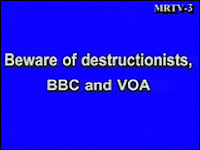


Screen grab from Burma's state-run English language TV - 27/09/2007
Despite the government's best efforts to drown out independent voices, images and uncensored information are still getting out of Burma.

Some people in Burma are circumventing the government's firewalls by uploading pictures directly to data hosting sites, which are harder to trace, instead of sending images by e-mail, says Moe Myint from the BBC Burmese Service.
Journalists in exile are using their networks of contacts back home to get images and information out of the country and on to blogs and satellite TV - and back into Burma.