It has become a cliche: The truth will set you free.
But Bob Woodward really does believe that transparency is central to democracy.
Julia Love reports:
In a speech before an overflowing crowd in the Sanford School of Public Policy Wednesday, Woodward said it was a simple drive to explain what happened that led him through the legendary reporting on the Watergate scandal and the composition of 15 best-selling books.
“What worries me most is secret government.... Democracies die in darkness,” he said. “All the other problems I think we’ll fix.... But look at history. If we don’t know what’s going on, we’re going to die.”
Since the early 1970s, Woodward has made a career out of illuminating some of the most secretive annals of American government.
As a 29-year-old reporter for The Washington Post, Woodward and his colleague, Carl Bernstein, wrote a series of stories that forced President Richard Nixon, Law ’37, to resign over charges of burglary, money laundering and wiretapping, among other offenses in a scandal that would come to be known as “Watergate.” Within a year, Woodward rose from obscurity to become one of America’s best-known journalists.
Watergate remains his legacy, but Woodward has written more than a dozen books about the drama of Washington since. Two years into the Obama administration, Woodward released his first account of the presidency, “Obama’s Wars,” which exposes the inner workings of an administration sharply divided on how to proceed in Afghanistan. The military’s top brass argued that a significant troop increase would turn the tide of the war, but others close to the president—including Vice President Joe Biden—pushed for a more conservative approach.
Woodward paints a portrait of a president eager to end the war. Indeed, he said Obama questioned many of the underlying assumptions behind U.S. strategy in Afghanistan and questioned the need for a surge before eventually deciding to send 30,000 more troops.
Woodward discussed his latest book’s revelations with Peter Feaver, Alexander F. Hehmeyer professor of political science, in a conversation sponsored by the Duke Program in American Grand Strategy, Sanford, the Triangle Institute for Security Studies and Duke University Union.
When the veteran journalist began exploring the administration’s handling of the war in Afghanistan, a senior Obama aide told him he “was not going to find many Deep Throats”—a snide reference to the informant who was one of Woodward’s main sources during the Watergate scandal. Within months, the same aide produced notes for Woodward from confidential meetings with the president.
“It’s neutral inquiry. I’m not for Bush, against Bush, for Obama, against Obama,” he said. “I think there is a little bit of a believer of the First Amendment in everyone, and if you take them as seriously as they take themselves... you can win people’s cooperation in quarters that you can’t imagine.”
Woodward slammed Nixon as a leader who abused the power of the presidency as “an instrument of personal revenge.” Although he has watched Presidents Bill Clinton, Bush and Obama with a diligent eye, Woodward has not found any evidence of moral bankruptcy.
“The happy discovery about certainly Clinton, Bush and Obama is it is a good faith effort to do the right thing,” he said.
Woodward noted that he was never granted an interview with Nixon, though he amassed enough damaging evidence to end his presidency. The journalist has enjoyed rare, extended access to Nixon’s successors, referencing a three-and-a-half hour interview with Bush and a lengthy conversation with Obama.
The nature of the conversations strikes at the heart of who the men are. Woodward joked that he was hard-pressed to ask one question in an interview with Clinton. But in the extended interview with Bush, the former president’s short, direct style enabled Woodward to ask 500 questions.
“Bush told me, ‘I am a gut player, not a textbook player,’” he said.
Obama, on the other hand, is all textbook, Woodward said. In the way the president leads, Woodward sees a consummate professor always trying to identify issues and answer questions. Obama is, in effect, his own national security adviser, Woodward said.
Yet Woodward said the war in Afghanistan traps Obama in an ideological conflict: he despises war, but he is the commander-in-chief. Woodward said Obama told him his task is to “impose clarity on the chaos of war.”
“He wants out of Afghanistan,” Woodward said. “You listen to his speeches and that doesn’t come through. But digging under the surface it does, and I, quite frankly, think it is important for the public to know that the commander-in-chief wants out.”
Woodward suggested that failures of communication were almost to be expected between men who have not taken the time to get to know each other. Indeed, after Obama selected Gen. Stanley McChrystal to lead the charge in Afghanistan, their interaction consisted of a 10-minute photo-op.
“I said to Obama, ‘You’re picking your Eisenhower,’” Woodward recounted. “Obama said, ‘Well that would mean it’s World War II and I’m FDR, and I’m not.’ And I said, ‘But this is your war.’”
Bush, too, failed to take the time to form strong personal relationships with members of his supporting cast, Woodward said. Robert MacNamara, who served as Secretary of Defense under Presidents John Kennedy and Lyndon Johnson, understood the complexities of these relationships, Woodward said, sharing an insight from one of the last interviews the man gave before he died.
“Presidents want harmony.... One of the points he made is that this drive toward harmony and collegiality among the team keeps things from really surfacing,” Woodward said. “Sometimes issues surface in my interviews that didn’t surface enough in the internal discussions.”
Woodward’s long history in Washington enables him to leap from administration to administration with ease, drawing helpful connections as he goes—as if the architects of the Vietnam War and the surge in Afghanistan could whisper to each other. Barring a Watergate episode, presidents serve for four or eight years, but Woodward has made them sweat for nearly four decades.
While chasing a story recently, Woodward found himself unable to land an interview with a key general. After countless e-mails, Woodward took matters into his own hands and knocked on the man’s door at 8:15 p.m., which he noted is always a convenient time to reach sources.
“He answers the door and he asks me, ‘Are you still doing this s—?’” Woodward said with a laugh, recalling that the general ushered him inside.
Thursday, October 28, 2010

Monday, October 11, 2010
Newsweek sniffs out Daily Beast's Brown
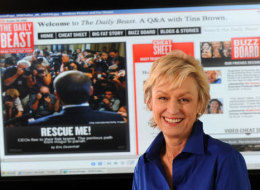 There have been prominent WashPost and Newsweek links on the Daily Beast website since its launch two years ago, and now that the nation's number two news magazine, Newsweek, has changed hands for only a dollar to a deep-pockets owner willing to take on its debts, the redoubtable Ms Brown of the Daily Beast may soon up for double editorial duties and double exposure. She's always been more a features gal than a breaking news buff, so it will be fun to watch her later trajectory. The supposed rivalry between her and Arianna Huffington, the other aggregate cyber siren, has been satirized on Arianna's website.
Hat tip to Romenesko, via NY Times and WS Journal for the following story:
As speculation continues about a merger between The Daily Beast, the news and opinion Web site financed by Barry Diller, and Newsweek, The Wall Street Journal reports that the likelihood of a deal is increasing.
The Journal, citing people familiar with the discussions, said as part of the deal currently being discussed by the two companies, Tina Brown, The Daily Beast’s co-founder and co-owner, would become the editor of Newsweek, on top of her existing editorial duties at the Web site.
Speculation about a possible tie-up between the two companies resurfaced last week after Howard Kurtz, a three-decade veteran of The Washington Post, announced he was leaving to join The Daily Beast. Industry watchers suggested that Newsweek would provide a more logical home for Mr. Kurtz’s work given his long tenure as a print reporter.
However, the newspaper said that Sidney Harman, the audio equipment magnate who bought Newsweek in August, may be concerned about issues of control:
People familiar with Mr. Harman’s thinking said he may be wary of handing the reins to a strong-willed editor who also answers to another boss—Barry Diller, chairman and chief executive of Daily Beast owner IAC/InterActive Corp.
Newsweek, which Mr. Harman bought from The Washington Post Company for $1, lost almost $30 million last year amid circulation and advertising declines.
Meanwhile, The Daily Beast, which averages 4.6 million visitors a month, is expected to lose about $10 million this year, The Journal said, citing a person familiar with the matter.
However, The Daily Beast executives say the portal is on its way to becoming profitable in two years, according to the Journal.
Last week, in a piece marking The Daily Beast’s second anniversary, Ms. Brown responded to the buzz about a deal with Newsweek by saying: “Yes, there have been some interesting discussions going on, as we have with potential partners large and small all the time.”
Wednesday, October 6, 2010
Russ Baker exposes Woodward's 'inner warrior' and the icon's feet of clay

Bob Woodward’s signature achievement - bringing down Richard Nixon - turns out not to be what we all thought. If that comes as a surprise, you have missed a few books, including bestsellers, that put pieces of this puzzle together. (Family of Secrets has several chapters on the real Watergate story, but there are others that present detailed information, including those by Len Colodny and Robert Gettlin, James Rosen, Jim Hougan and others.)Hat tip to Russ Baker & Truthout
Here’s the deal: Bob, top secret Naval officer, gets sent to work in the Nixon White House while still on military duty. Then, with no journalistic credentials to speak of, and with a boost from White House staffers, he lands a job at the Washington Post. Not long thereafter he starts to take down Richard Nixon. Meanwhile, Woodward’s military bosses are running a spy ring inside the White House that is monitoring Nixon and Kissinger’s secret negotiations with America’s enemies (China, Soviet Union, etc), stealing documents and funneling them back to the Joint Chiefs of Staff. They then give what they stole to columnist Jack Anderson and others in the press.
That’s not the iconic Woodward of legend, of course — so it takes a while for this notion to settle in the mind. But there’s more — and it’s even more troubling. Did you know there was really no Deep Throat, that the Mark Felt story was conjured up as yet another layer of cover in what became a daisy chain of disinformation? Did you know that Richard Nixon was loathed and feared by the military brass, that they and their allies were desperate to get Nixon out and halt his rapprochement with the Communists? That a bunch of operatives with direct or indirect CIA/military connections, from E. Howard Hunt to Alexander Butterfield to John Dean — wormed their way into key White House posts, and started up the Keystone Kops operations that would be laid at Nixon’s office door?
Believe me, I understand. It sounds like the “conspiracy theory” stuff that we have been trained to dismiss. But I’ve just spent five years on a heavily documented forensic dig into this missing strata of American history, and I myself have had to come to terms with the enormous gap between reality and the “reality” presented by the media and various establishment gatekeepers who tell us what’s what.
Given this complicity, it’s no surprise that when it comes to Woodward’s latest work, the myth-making machine is on auto pilot. The public, of course, will end up as confused and manipulated as ever. And so things will continue, same as they ever were. Endless war, no substantive reforms. Unless we wake up to our own victimhood.
Monday, September 27, 2010
Fisk on Fisking

Fisking is an internet term for a "point-by-point debunking of lies and/or idiocies", which is not necessarily fun to read. It started when Robert Fisk wrote the following lines about a beating
If I was an Afghan refugee in Kila Abdullah, I would have done just what they did. I would have attacked Robert Fisk. Or any other Westerner I could find
Apparently, the reporter was setting himself up for a different kind of bruising. In the blogosphere, Fisk's article was widely mocked for its mawkishness. The Ur-fisking below is blogger Andrew Sullivan's takedown of Robert Fisk's page one account of being attacked by Afghans. Sullivan's fisking was nearly a fisting, some bloggers observed, before promptly imitating the tiresome style. Geekish wingnuts soon became particularly prone to the pastime of fisking, and it's the usual modus operandi of the text-scourers who run the so-called Committee for Accuracy in Middle East Reporting in America (CAMERA).
Here's Sullivan, back in 2001 when he was also penning loveletters to "Rummy", the reprehensible Donald Rumsfeld.
THE PATHOLOGY OF ROBERT FISK: His account of his ordeal at the hands of an Afghan mob – a mob that apparently cried “Infidel!” as they attacked and tried to rob him – is a classic piece of leftist pathology. You have to read it to believe it. Even when people are trying to murder Fisk, he adamantly refuses to see them as morally culpable or even responsible. I’ve heard of self-hatred but this is ridiculous: “They started by shaking hands. We said, 'Salaam aleikum' – peace be upon you – then the first pebbles flew past my face." That sentence alone deserves to go down as one of the defining quotes of the idiotic left. If it weren't so tragic, it would be downright hilarious. Who needs Evelyn Waugh when you have this?
"I WOULD HAVE DONE THE SAME": But wait, there's more. "A small boy tried to grab my bag. Then another. Then someone punched me in the back. Then young men broke my glasses, began smashing stones into my face and head. I couldn't see for the blood pouring down my forehead and swamping my eyes. And even then, I understood. I couldn't blame them for what they were doing. In fact, if I were the Afghan refugees of Kila Abdullah, close to the Afghan-Pakistan border, I would have done just the same to Robert Fisk. Or any other Westerner I could find.” What does this mean, you might well ask? What it means is that someone – anyone – is either innocent or guilty purely by racial or cultural association. An average Westerner is to be taken as an emblem of an entire culture and treated as such. Any random Westerner will do. Individual notions of responsibility or morality are banished, as one group is labeled blameless and another irredeemably malign. There’s a word for this: it’s racism. And like many other members of the far left, Fisk is himself a proud racist, someone who believes that the color of a person’s skin condemns him automatically and justifies violence against him. So the two extremes touch and are, in fact, interchangeable. Rightist racism springs from the premise that some races are somehow morally superior. Leftist racism springs from the premise that some races are also morally superior. The only difference is the color of skin. Alleged “victimization” sanctifies any evil perpetrated by the oppressed race. Just as the Nazis and Communists claimed self-defense for the mass-murder of their “oppressors,” so some modern leftists claim the absolution of self-defense even for a mob attacking a carful of innocent, harmless journalists. Or a sky-scraper for that matter.
THE VICTIM OF THE WORLD: You know the expression: you wouldn't understand a culture if it actually hit you in the head? Fisk has now officially retired that expression as a metaphor. He goes on: “There were all the Afghan men and boys who had attacked me who should never have done so but whose brutality was entirely the product of others…” Notice that phrase – “whose brutality was entirely the product of others.” What can that possibly mean? We’re not talking about extenuating circumstances – things that might help us understand or contextualize the hatred of one people for another. We’re talking about a priori moral absolution. Take this passage: “Goddamit, I said and tried to bang my fist on my side until I realised it was bleeding from a big gash on the wrist – the mark of the tooth I had just knocked out of a man's jaw, a man who was truly innocent of any crime except that of being the victim of the world.” No, Mr. Fisk, that man who attacked you was not truly innocent of any crime. You were. He was not the victim of the world. You were the victim of a thieving, violent mob. For those who believe that the left-wing intelligentsia is capable of critical thought or even a modification of their ideology in the face of evidence, this incident is a wonderful example of why it won’t happen. They won’t recognize reality, or abandon their racism, or moderate their spectacular condescension to the inhabitants of the developing world – even when reality, literally, crushingly, punches them in the face.
When the Feral Beast encountered Robert Fisk this weekend, the topic of fisking was raised. As a reporter whose name has become a verb, what does he feel about fisking nine year on?
"But that only exists on the internet, not in the real world, so it's of no concern," the veteran war reporter mused between sips of his gin and tonic. This Brit still eschews the hate-spewing virtual world. He is a reality maven, and quickly comes across as an erudite trainspotter, planespotter and weaponry gearhead. The Independent's intrepid reporter, who has expanded his beat outward from the Middle East to include Southwest Asia and now India, takes pride in remaining a cyber-Luddite. The sun doesn't seem to set on Fiskworld. His command of dates and details while speaking extemporaneously is most impressive. And he doesn't mince words, self-censor or run with the hack pack. Oddly, his fans have designed a couple of Facebook pages for him anyway.
Sunday, September 26, 2010
A Muslim Superhero Hits Comics

A Muslim Superhero Hits Comics - The Daily Beast
A super-Muslim on wheels is about to hit the stands, acc to the Associated Press The unlikely comic book hero is the brainchild of U.S. philanthropist and businessman Jay T. Snyder.
He told the AP that he was inspired by President Barack Obama's effort to reach out to the Muslim world in his January 2009 inaugural address. Last month, Snyder flew 12 disabled Americans to Damascus to meet a group of disabled young Syrians, and one of their main goals was to come up with ideas and story lines for the new superhero.
Tuesday, September 21, 2010
RIP Murray Sayle: adventurer and tireless investigator of 1945 Atomic Bombing

Peter Popham writes in the Independent about the life of an investigative reporter, and the demise of an industry.
A big, barrel-chested, hatchet-faced man with a broken nose and a sardonic smile, Murray Sayle was one of the most brilliant journalists of his generation and at his frequent best demonstrated a passion for his craft both as a tool for establishing truth and as a vehicle of literary delight. All you needed to be a journalist, he liked to quip, was a little literary ability and rat-like cunning. But behind the Aussie cynicism lay a belief in the value of his profession when practiced with total commitment which was an inspiration to many who crossed his path. Few journalists took their investigative work more seriously, or placed more onerous demands on their chosen editors.
Murray was an outstanding member of the great Australian literary diaspora that hit London from the early-1950s onwards and included such stars as Germaine Greer, Richard Neville, Philip Knightley and Clive James. Like them he possessed a protean energy and a refusal to acknowledge conventional boundaries or limitations which left their British competitors gasping.
The son of a railway executive, born in New South Wales in 1926, he studied psychology at the University of Sydney but became so absorbed in his work for the student magazine, Honi Soit, that he missed 90 per cent of his lectures and was excluded from taking his finals. He made up for it some 64 years later when the university awarded him an honorary doctorate.
On leaving university he was quickly taken up by the Sydney media, working for the Sydney Daily Telegraph and the Daily Mirror and national radio. Then in 1952 he left for London where he was hired by The People, at the time a vigorous and very profitable Sunday scandal sheet. Working alongside the paper's legendary crime reporter Duncan Webb he picked up, or possibly invented, the catchphrase, "I made an excuse and left."
But his first marriage was breaking up and in 1956 he left The People, journalism and London, beginning an improbable interlude selling encyclopaedias in Germany and writing a novel based on his Fleet Street experiences entitled A Crooked Sixpence. It might have made his name had not a friend called Michael Alexander, who was broke at the time and hoping for an easy pay-out, complained to the publisher that one of the novel's characters was based on himself, threatening to sue. Instead of paying him to shut up the publisher pulped all copies and the book disappeared without trace. It was recently re-published and acclaimed as a Fleet Street classic.
By the mid-'60s he was back in London and doing newsroom shifts at the Sunday Times, where his tireless digging for facts, his vigorous, flinty style and his ironical wit soon got him noticed. Harold Evans, the legendary editor of the Sunday Times, made him the paper's chief foreign fireman, with license to roam the world's hot spots, reporting the Vietnam, Indo-Pakistan and Six-Day wars among other big stories, and being awarded Journalist of the Year for his Vietnam reports. But Murray was never satisfied in running with the pack, and his most memorable and extraordinary dispatches were all done solo: using a light airplane to track the round-the-world yachtsman Francis Chichester as he sailed around Cape Horn, then, on the same expedition, searching for (though not actually locating) Che Guevara in Bolivia, becoming the first journalist to report that the guerrilla leader had left Cuba for South America.
Sayle also exploited his cachet as one of Harry Evans's "licensed eccentrics" to climb Mount Everest and sail single-handed across the Atlantic, among other macho exploits on the margins of serious journalism. But as a veteran war reporter his obsession, lasting for the rest of his working life, was with official violence and the lies with which it becomes encrusted to justify or obfuscate it.
His investigation into Bloody Sunday in 1972 led him to the conclusion, vindicated in the government's admission earlier this year, that the British paratroopers had not been fired on by those they shot, killing 13. But when the Sunday Times spiked his report, with its claim that the killings had been planned in advance, he resigned, and his mercurially brilliant London career was over.
With his second wife Jenny Murray he moved east, first to Hong Kong and then, in 1975, to Japan, which was to become the family's home for nearly 30 years. They settled in the remote and entirely obscure village of Aikawa, in Kanagawa Prefecture, where they lived in a traditional wooden house, freezing cold in winter, from which Murray would descend on the Foreign Correspondents' Club in central Tokyo at intervals to hold court among his peers. But despite the apparent seclusion, these were years of great productivity: he had arrived in Japan at the most pregnant moment of its postwar history, and was to witness and record its long years of boom, its precipitous slump and slow recovery in witty, erudite and immensely long pieces for The Independent Magazine, the New Yorker and the New York Review of Books, among others. His obsession with official cover-ups remained a constant: he wrote copiously about Tiananmen Square and the disappearance of the Korean airliner KAL007, reaching controversial conclusions backed by exhaustive research.
His crowning journalistic achievement, for which the New Yorker cleared out an entire issue in 1995, was entitled "Did the Bomb End the War?" and concerned one of those facts that "everybody knows" but which, in his view, was not actually true: the notion that it was the atom-bombing of Hiroshima and Nagasaki that persuaded the Japanese to surrender. Sayle advanced a powerful case for believing that actually it was the Soviet invasion of Manchuria, with the implicit danger that they would then invade Hokkaido and force a division of Japan like that of Korea, which was actually the crucial event.
The Sayle family moved back to Australia in 2004 when Murray was diagnosed with Parkinson's disease. His honorary doctorate described him as "a witness to history in the classic tradition of journalism and foreign correspondence." That a career such as his is unthinkable today, with or without a video camera to hand, is a measure of how much more challenging the profession has become.
Thursday, September 9, 2010
The Problem With Burning Qurans

What if they burnt a Koran and nobody came? It already happened two years ago, according to the NY TIMES. Some soul-searching is under way in the media. And in The Problem With Burning Qurans Tunku Varadarajan dissects the latest media frenzy - what Arianna Huffington likens to the Balloon Boy.
What is the media responsibility in this coverage? Can the genie be put back into the bottle at this stage? Burn, baby , burn!
Subscribe to:
Posts (Atom)