Sunday, September 30, 2007

Buzz-builders leak news content to bloggers

Are you being served? Are you being used?
The Economist is courting blogs to drive up online viewing statistics. The journalism.co.uk site discloses how blogs and aggregation sites now are the main source for links to newspaper sites.

"What we've found to be very successful for getting views is to actually engage with bloggers," said Mike Seery.

"In the US we identified the 100 most important political bloggers and we effectively give them content before it's published in print, so that it builds a buzz around the thing before it's there.

"It takes work and it's not the exclusives you might get in a national daily here [in the UK], but it's the sort of thing that create a big buzz and brings lots of traffic the next day," he added.


Brave new world.

Friday, September 28, 2007

japanese journalist shot dead by the military in burma

A 50 year old cameraman, Kenji Nagai, was gunned down in the Rangoon street while covering the protests. Many more are believed killed, although the junta admits only to nine deaths and is moving to suppress media reports by cutting mobile phone and internet connections.

cure for hacks' cyber-obsession

Thursday, September 27, 2007

Covering Ahmadinejad at Columbia


Student videos like this show a "new journalism" take on student viewpoints at rallies outside the New York speech of Mahmoud the Mouth. More can be seen here.

Meet Josef, Mikki, Matthew and Fatemeh, four different faces of students protesting, and listen to some Hebrew singing and accordion and banjo playing.

The Security of Free Speech
Almost one year ago, student protesters stormed the stage in Columbia’s Roone Arledge Auditorium when controversial Minuteman founder Jim Gilchrist took the podium to speak.

When Mahmoud Ahmadinejad, the even more controversial president of Iran, took the same stage Monday, Columbia was better prepared. Uniformed police officers, intelligence officers, Secret Service, and the FBI monitored campus and the surrounding streets. Silver barriers lined Broadway Avenue between 113th and 116th streets, and 114th Street was closed to cars.

The protesters—police estimated 1,000 total—clustered at Columbia’s main gate on 116th Street and Broadway Avenue. A man flew Israel’s flag on his back. Taxis and a Fresh Direct truck beeped as they drove slowly by a “Honk if you hate terrorists” sign. Police officers stood ready with billy clubs tucked into their belts

Students approaching the main gate had to elbow their way through a forest of signs and dodge the pamphlets thrust at them. An officer with a bullhorn bellowed, “Show your ID card.” Associate Vice President for Public Safety Jim McShane sent a campus-wide e-mail last Friday warning that entry would be restricted to those with a Columbia ID.

Raphael Levy, a junior, said the event was more exciting than annoying. “I tried to stay away from the mob,” he said. But he did join other students who packed the ledge overlooking 116th street, staring at the protesters below. “I heard people got into fights,” he said, although he hadn’t seen any himself. Police said there were no arrests.

Ahmadinejad’s visit was notable not just for what he said but also for the ease with which he said it. The wheels of free speech were oiled by NYPD Intel and Secret Service in their shiny black suits, by police officers with billy clubs, and by Columbia officials shutting the gates to anyone without a University ID.

(hat tip to Candice Hughes for the link.)

Burma-shaving the truth

The generals' iron fists are shaking at a so-called 'Sky-full of lies' which threatens the Burmese junta's grip on power, the biggest challenge since the slaughter of 8/8/88
As Burmese soldiers fire bullets and tear gas to disperse anti-government protests in Rangoon, the military rulers have taken the offensive in the battle to control the flow of information in the country, says the BBC.

Websites and internet blogs posting information and photographs of the government's action have been blocked.

Telephone lines and mobile phone signals to monasteries, opposition politicians and student leaders have been cut. A hotel where foreign journalists lodge was surrounded and ransacked.

All this has made it more difficult for people to upload pictures of the mass protests to be picked up by international satellite news channels and beamed around the world, including back to Burma.

In a sign that the military junta in Burma is afraid of foreign radio and satellite TV coverage of the protests and the junta's crackdown, the state-run media has begun to blame foreign media for inciting the trouble.

The Light of Myanmar newspaper said: "Saboteurs from inside and outside the nation and some foreign radio stations, who are jealous of national peace and development, have been making instigative acts through lies to cause internal instability and civil commotion."

The official English-language television station, MRTV-3, has said that people are being intimidated into joining the demonstrations.

State media is airing the official view of events in Burma
Screen captions ran scrolling messages saying: "We favour stability. We favour peace. We oppose unrest and violence."

Another screen caption, also read by an announcer, said the BBC and the Voice of America were broadcasting "a sky-full of lies". Another said: "Beware of destructionists, BBC and VOA".
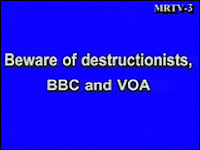


Screen grab from Burma's state-run English language TV - 27/09/2007
Despite the government's best efforts to drown out independent voices, images and uncensored information are still getting out of Burma.

Some people in Burma are circumventing the government's firewalls by uploading pictures directly to data hosting sites, which are harder to trace, instead of sending images by e-mail, says Moe Myint from the BBC Burmese Service.
Journalists in exile are using their networks of contacts back home to get images and information out of the country and on to blogs and satellite TV - and back into Burma.

Tuesday, September 25, 2007

When Satchmo made a historic squawk


Reporters, even when covering celebrities, can change the course of history.
This bright little nugget by David Margolick in the International Herald Tribune recounts what transpired when Lubenow, an enterprising cub reporter, persuaded Louis Armstrong to speak out about the segregation problems in Little Rock, Arkansas half a century ago.

"It's getting almost so bad a colored man hasn't got any country," a furious Armstrong told him [the reporter]. Eisenhower, he charged, was "two faced," and had "no guts." For Faubus, he used a double-barreled hyphenated expletive, utterly unfit for print. The two settled on something safer: "uneducated plow boy." The euphemism, Lubenow says, was far more his than Armstrong's.

Armstrong bitterly recounted some of his experiences touring in the Jim Crow South. He then sang the opening bar of "The Star-Spangled Banner," inserting obscenities into the lyrics and prompting Velma Middleton, the vocalist who toured with Armstrong and who had joined them in the room, to hush him up.

Armstrong had been contemplating a good-will tour to the Soviet Union for the State Department. "They ain't so cold but what we couldn't bruise them with happy music," he had said. Now, though, he confessed to having second thoughts. "The way they are treating my people in the South, the government can go to hell," he said, offering further choice words about the secretary of state, John Foster Dulles. "The people over there ask me what's wrong with my country. What am I supposed to say?"

Lubenow, who came from a small North Dakota farming community, was shocked by what he heard, but he also knew he had a story; he skipped the concert and went back to the paper to write it up. It was too late to get it into his own paper; nor would the Associated Press editor in Minneapolis, dubious that Armstrong could have said such things, put it on the national wire, at least until Lubenow could prove he hadn't made it all up.

So the next morning Lubenow returned to the Dakota Hotel and, as Armstrong shaved, had the Herald photographer take their picture together. Then Lubenow showed Armstrong what he'd written. "Don't take nothing out of that story," Armstrong declared. "That's just what I said, and still say." He then wrote "solid" on the bottom of the yellow copy paper, and signed his name.

Monday, September 24, 2007

Incestuous plot in London

These sister papers should not marry, hurrumphs Stephen Glover, a media analyst at the Independent newspaper.


One story you will not have seen in MediaGuardian concerns goings-on at 'The Guardian' and 'The Observer'. As I wrote here a little over two months ago, there have been discussions about turning 'The Observer' into a seven-day version of its daily sister paper. The 'Evening Standard' has even suggested that Roger Alton, 'Observer' editor, may be considering his position. He denies this.

The rationale for making 'The Observer' into some sort of Sunday version of 'The Guardian' is that it is losing a good deal of money. Integrating some departments would reduce losses. A similar thought process has been going on at the 'Telegraph' papers, where there appear to be plans afoot (though they are denied) to make the Sunday title closer to the Daily one.

The contrary case is that making 'The Observer' into a seventh day 'Guardian' would weaken it. I would like to know of a successful instance in this country of a Sunday paper being successfully merged with its daily stablemate. Almost invariably, the process, having been embarked upon, is reversed. Of course, some resources, such as foreign correspondents, can be shared. But if it is to punch its weight in a very competitive market, a Sunday title needs its own editor and staff.

One can understand why the Guardian Media Group should be concerned by losses at 'The Observer', but I hope it keeps it separate. In 1993, Newspaper Publishing, then owner of 'The Independent', almost acquired 'The Observer' with the idea of merging it with the 'Independent on Sunday'. At the last moment 'The Guardian' bought the paper with the assurance of keeping it alive as a separate title. It must not break this pledge.